



Home / Products / Thin Film Coatings / Plate Beam Splitters
Optical Beam Splitters
45° Splitter Mirrors, DST series
Special Properties
- Neutral division of light beams, lasers, and images
- Anti-reflection-coated back side
- Suppression of double images and ghost reflections
- Low-absorption dielectric layer system
- Designed for unpolarized light
- 100% metal-free
- Large dimensions possible (DST500)
Typical Applications
- Beam splitters for optical systems and laser applications
- Divider mirrors for reference measurement systems
- Partially transparent splitters for interferometers
- Measurement and sensor technology
- Applications in photonics and photon research
- Image processing in automation technology
- Laser combination mirror
- Machine vision and industrial image processing
- Plate beam splitters for optical benches
- Applications of fiber-optic technology
- Optical data-transmission
- LED measurement devices
- SIR Series
(IR-reflecting dichroic beamsplitters) - SHD Series
(IR-transmitting dichroic beamsplitters) - ND filters
(Attenuation filters made from SCHOTT NG materials) - TDS Spy-Mirrors
(Partially transparent “one-way mirror”)
Beam Splitters are Core Elements in Optics
Beam splitters are essential components in optical systems for telecommunications, spectroscopy, microscopy, laser technology, machine vision and research. They split incident light into two components, deflected in different directions and function as dividing mirrors or partially transparent optics.
Precise Light Division with Minimal Loss
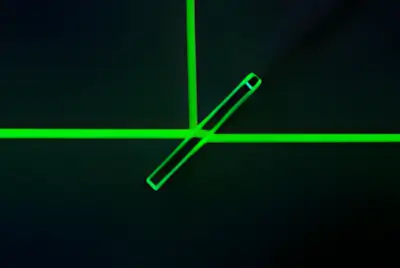 Our DST beam splitters divide incident light into transmission and reflection components at defined ratios at an angle of incidence of 45°. The dielectric thin film coating on the front surface determines the splitting ratio. A broadband anti-reflection coating on the back side suppresses secondary reflections, ghost images, and phantom beams, eliminating reflection losses and blurring. The substrate material we use for the DST is iron-reduced float glass with low absorption and optical display quality.
Color-Neutral and Highly Efficient
Unlike dichroic beam splitters, which separate spectral ranges, DST splitters divide the visible spectrum in a color-neutral manner. The non-metallic dielectric design provides durability and abrasion resistance. All DST coatings exhibit low optical absorption in the nominal wavelength range, drastically minimizing energy loss compared to metallic beam splitters. These characteristics make DST splitters suitable for optical benches and reference measurement systems, where lasers with low to medium power are split into multiple beams with minimal loss.
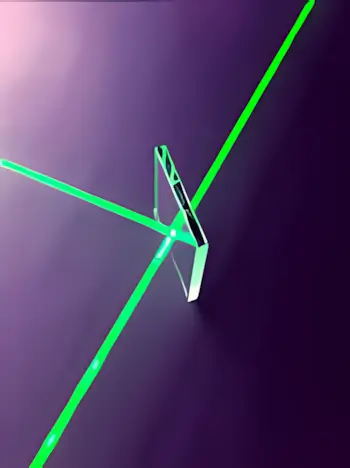 DST beam splitters are designed for unpolarized light. When used with polarized light sources or polarized lasers, splitting ratios may deviate from the specifications listed in this data sheet, which only apply to unpolarized light. The splitters are not optimized for specific polarization behavior. In some cases, polarized light sources can be accommodated by selecting an alternate splitting ratio (higher or lower), reducing costs compared to custom coating batches.
Customized and Polarizing Beam Splitters
Beam splitters for polarized light sources, including polarized lasers, require specification of wavelength, splitting ratio, laser power, and other relevant parameters. Polarization-optimized, customized splitter optics are available for larger production runs. Beyond the standard DST300, DST500, and DST700 series, other splitting ratios are available on a batch basis. Polarizing beam splitter cubes, pentaprisms, NIR dividing mirrors, and other specialized beam splitters can be manufactured to customized specifications. All custom components can be requested through the inquiry form.
Individual Dimensions
Beam splitters with individual dimensions can be manufactured on short notice. Customized beam splitters based on the existing DST coatings are typically delivered as quickly as stock products, including for large production quantities.
To request a DST beam splitter with custom dimensions, click the button below:
 48-hour express manufacturing
Specifications
DST300
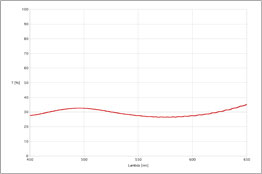
Enlarged view of the DST300 curve
DST500
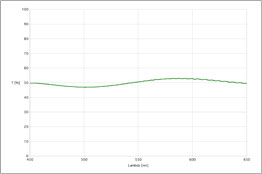
Enlarged view of the DST500 curve
DST700
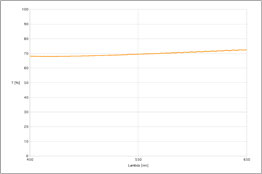
Enlarged view of the DST700 curve
To inquire, please click on a thickness:
| Thickness (mm) | Tolerance | |
|---|---|---|
| DST300 beamsplitters R : T = 70 : 30 |
||
| 1.00 | ±0.10 | ✔ |
| DST500 beamsplitters R : T = 50 : 50 |
||
| 1.00 | ±0.10 | ✔ |
| DST500T beamsplitters R : T = 50 : 50 |
||
| 3.30 | ±0.20 | - |
| DST700 beamsplitters R : T = 30 : 70 |
||
| 1.00 | ±0.10 | ✔ |
| Other thicknesses per inquiry. | ||
| All DST beamsplitters have an AR coating on the back. | ||
| Thicknesses marked with ✔ are also available in our 48-hour express service. | ||
- Up to approx. 630 mm × 810 mm (only for flat beamsplitter plates, not possible for prisms, NIR beamsplitters, polarizing optics, or beamsplitter cubes.)
Splitting Ratios at 45° Angle of Incidence
(All ratio data refer to random polarization.)
DST300
- R/T = 70/30 (± 10%) for 450–650 nm
DST500
- R/T = 50/50 (± 6%) for 450–650 nm,
R/T = 50/50 (± 10%) for 430–685 nm
DST500T
- R/T = 50/50 (± 10%) for 450–650 nm
DST700
- R/T = 30/70 (± 8%) for 450–650 nm,
R/T = 30/70 (± 10%) for 400–700 nm
Other division ratios are available on demand.
- Selected float glass
- BF33 Borosilicate glass (DST500T only)
- Other substrate materials per inquiry
- Depends on material and thickness
- Better than 80-50 scratch & dig (MIL-0-13830A)
- Other qualities per inquiry
- Adherence according to MIL-C-675 C (tape test)
- Abrasion resistance according to MIL-M-13508 C
If you require further information or cannot find the divider mirror you are looking for on our website, please send us your request.
All details and specifications given are mean reference values and are not guaranteed. Please also consider our “Notes on Technical Specifications”.
© 1994–2026 Präzisions Glas & Optik GmbH
Last update: September 23, 2026