



Neutral Density Filters – ND filters
SCHOTT NG 1, NG 3, NG 4, NG 5, NG 9 and NG 11
Special Properties
- Mass-dyed, absorbent filter glasses
- Neutral filtering effect with low color distortion
- High optical densities can be achieved
- Uniform light attenuation
- Wide selection of filter glasses with various density values
- Transmission and density depend on the thickness
- Almost independent of the incident angle
Typical Applications
- Controlled attenuation of light
- Neutral attenuation filters for optical measuring instruments
- Optical reference standards
- Accessories for optical calibration devices
- Neutral density filters for camera lenses
- Filter sets for the laboratory
- ND filters in front of measurement sensors
- Filters for extending the exposure time of camera systems
- Camera and lens attachments for shooting at wide apertures in bright light
- Attenuation filter for laser power meters
Related filters, coatings, and information
- SCHOTT Filters (SCHOTT color glass filters)
- DST-Series (beam splitters and dividing mirrors)
- SCHOTT filter calculator
Neutral density filters are also commonly referred to as ND filters, gray filters, OD filters, or optical density filters. Neutral density filters provide nearly constant, color-neutral transmittance and show minimal dependence on the wavelength of the incident light within a wide spectral range. This enables precise control of light levels in optical systems. A significant advantage of absorptive density filter optics is that their transmittance does not strongly depend on the incidence angle, unlike what is the case for most filters based on thin-film coatings.
The suitable NG grey filter material and the appropriate density are selected under consideration of the desired target light transmittance defined for 546 nm (see table). Hence, almost any required filter density and transmittance are adjusted by setting the chosen ND filter material's thickness. In practice, the density is determined by test measurements of a raw gray filter material, which is then ground and polished to a thickness slightly above the calculated target thickness. When this thickness is reached, measurements are taken again, and the filter material is polished down further if necessary. In this way, the target value is approached as closely as possible.
Neutral density filters are often used in photography in front of the camera lens for exposure correction. The filters attenuate the incident light entering the camera lens to an acceptable level to achieve correct exposure, even when much light enters the camera lens. Moreover, significantly extended long-term exposures are possible. Using our online calculator, you can calculate the transmittance spectra of any NG grey filter material and any other SCHOTT filter with our easy-to-use online application.
We manufacture OD-filter sets according to your density specifications and detailed requirements for laboratory use or reference measurement applications. Each set is manufactured individually. Please send us your inquiry if you want to order an ND filter set.
To request a quotation for polished neutral density filters made of a SCHOTT NG grey filter material with individual dimensions and custom transmissivity requirements, please click the button below:
Important note on the specification of NG filter transmissions/densities:
The transmission of NG filters is determined by their thickness. As the material density varies slightly, it is usually more accurate to specify the desired transmission at a specific wavelength rather than the thickness. In production, this is then achieved by polishing and measuring, which means that the actual thickness may differ from the theoretical value. Therefore, either the thickness or the transmission can be specified – not both.
Specifications
Optical Transmission
SCHOTT NG1 at 470–590 nm
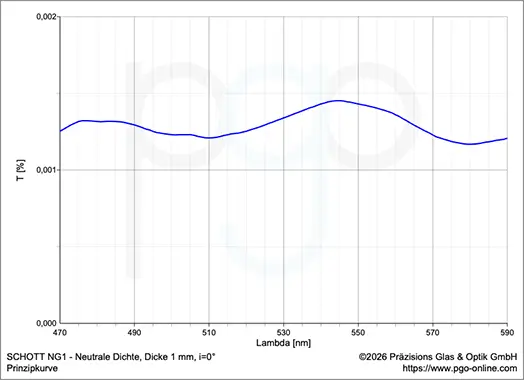
View transmission curve of NG 1 in the filter calculator
Note: The NG1 curve shown above is displayed with limited bandwidth. You can adjust the wavelength range and all other parameters to your requirements using our SCHOTT filter calculator.
SCHOTT NG3, NG4, NG5, NG9 and NG11
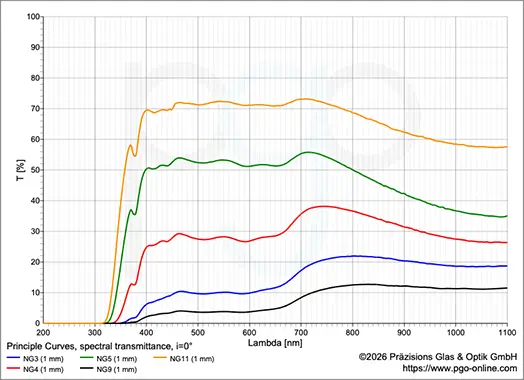
View NG3, NG4, NG5, NG 9 & NG11 transmission in the filter calculator
*Discontinued SCHOTT NG filters
The NG10 and NG12 filters are no longer in production. However, we may still have some remaining stock available. Please send us your inquiry if needed. You can find the specifications for these filters here:
• View Transmission curve of SCHOTT NG 10
• View Transmission curve of SCHOTT NG 12
Table of NG Filter Transmittance
(Defined for 546 nm at 1 mm filter thickness) Type |
Transmittance |
|---|---|
| NG 1 | 10-4 |
| NG 10* | 0.004 |
| NG 9 | 0.04 |
| NG 3 | 0.09 |
| NG 4 | 0.27 |
| NG 5 | 0.54 |
| NG 11 | 0.72 |
| NG 12* | 0.89 |
Filter Materials
- SCHOTT neutral density NG filter materials
(unpolished filter sheets)
Thermal Tempering
- Minimum thickness for full tempering = 3 mm
Flatness
- Depending on material and thickness
- Other qualities per request
Surface Quality
- typ. 80-50 scratch & dig (MIL-0-13830A)
- Other quality per request
Maximum Dimensions
- 165 mm × 165 mm (square or rectangle shape)
- ø 160 mm (round shapes)
Further detailed filter characteristics are available on request.
*The production of NG 10 and NG 12 neutral density filter materials has been discontinued. We might have some stock of those materials left.
All data and specifications given are average guide values and are not guaranteed. Moreover, please consider the “Notes on Specifications”.
© 1994 – 2026 Präzisions Glas & Optik GmbH
Last update: March 27, 2026