



Optical Quartz Glass – UV-Grade Fused Silica
Special Properties
- UV transmission >80% at 185 nm
- High purity glass composition (>99.99% SiO₂)
- Excellent optical quality
- Temperature resistance up to 1000 °C
- Low thermal expansion
- Amorphous (non-crystalline) structure
- Crystal-clear appearance
- High thermal shock resistance
- Outstanding chemical resistance
- High hardness and good scratch resistance
- Good electrical insulation
- Low fluorescence
- Made by a flame hydrolysis process
- High mechanical strength
- Machinable by CNC cutting, grinding, and polishing
Typical Applications
- UV and laser optics
- Substrates for mirrors and filter coatings
- Measuring instruments for the UV spectrum
- Wafers for the semiconductor industry
- Photomask blanks
- Microscope slides and cover glasses for medical use
- Optics for high-temperature equipment
- Laboratory test glasses
- Sample-storage solutions
- Space and aviation applications
Related Glass Types
Optical Quartz Glass — UV-Grade Fused Silica
Synthetic UV-grade fused silica is the most widely used quartz glass in optics – and for good reason. This clear, amorphous material is pure silicon dioxide (SiO₂). It does not contain additives or modifiers. That extreme purity, combined with a highly homogeneous structure, is what gives it the optical consistency required in UV spectroscopy, laser systems, and semiconductor manufacturing.
UV Transmission Properties
The absence of metallic impurities and other UV-absorbing contaminants is what sets optical quartz glass apart. Transmission at 185 nm exceeds 80% – a performance that most glasses cannot approach. The homogeneity of the SiO₂ network keeps both absorption and scattering losses low throughout the UV area, which matters wherever wavelength stability and transmittance integrity are critical.
Thermal Properties
Fused silica glass handles continuous operating temperatures up to 1000 °C and tolerates sharp thermal gradients without issue. Its coefficient of thermal expansion is exceptionally low, which allows for dimensional stability under thermal load which is a prerequisite for laser optics, semiconductor processing equipment, and any application where mechanical precision cannot be compromised by heat.
Chemical Strength
Fused silica resists virtually any substances: acids, alkalis, salt solutions, and reactive gases. The exceptions are phosphoric acid and hydrofluoric acid, both of which can attack the SiO₂ network. Outside those two, the material is chemically inert and holds up reliably even in aggressive process environments over long service periods.
Electrical Properties
The near-complete absence of mobile ionic impurities makes fused silica an excellent electrical insulator which maintains its insulation resistance at elevated temperatures where other materials start to fail. Its low dielectric constant and frequency-stable dielectric behavior, even into the gigahertz range, make it a practical choice for high-voltage, high-frequency, and precision electronic applications.
Optics Made of Quartz Glass
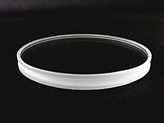 We fabricate quartz glass optics for UV, visible, and infrared applications from raw boules, selected for low inclusion and bubble content. Where the application demands it, we can achieve refractive index homogeneity of ≤ 0.5 ppm. Each optic begins with cutting the blank from the boule, followed by shaping and polishing to the required flatness and surface quality specifications. From this process we produce UV-transparent windows, wafers at various thicknesses, slides and sheets for microscopy applications, quartz plates, and various other parts daily.
Quartz Glass FAQ
Choosing the right grade
The range of available quartz glass grades, each with different optical, thermal, and chemical characteristics, can make the material choice complex. Our FAQ page walks through the key distinctions to help you identify the right material for your application.
To request a quote for optical quartz glass parts with custom dimensions, please select your thickness from the table or use the button below.
Get a price quote
 48-hour express manufacturing
Specifications
Spectral transmittance, UV to IR
160–5000 nm, 10 mm thick
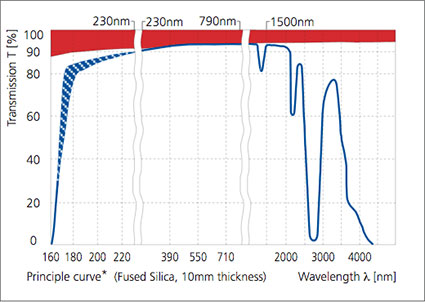
Show full transmission spectrum
Spectral transmittance
185–700 nm, 1 mm thick

Standard Thicknesses
Since fused silica is delivered in unprocessed blocks, there are usually no stock thicknesses. Therefore, a required thickness must typically be specified and manufactured to order. To offer our customers the best possible availability and short delivery times, we continuously grind and polish to some common thicknesses and tolerances, all featuring optical finishes. These thicknesses can therefore be ordered with individually specified dimensions and short delivery times:
Thickness |
Tolerance |
|
|---|---|---|
| 0.175 | ±0.020 | ✔ |
| 0.30 | ±0.050 | ✔ |
| 0.30 | ±0.025 | ✔ |
| 0.50 | ±0.050 | ✔ |
| 0.50 | ±0.030 | ✔ |
| 0.50 | ±0.025 | ✔ |
| 1.00 | ±0.100 | ✔ |
| 1.00 | ±0.025 | ✔ |
| 1.10 | ±0.100 | ✔ |
| 2.00 | ±0.150 | ✔ |
| 3.00 | ±0.200 | ✔ |
| 3.00 | ±0.025 | ✔ |
| If you require other thicknesses, please send us your inquiry. | ||
- T > 80% at 185 nm
- nd = 1.4585
- 2.20 g/cm3
- 74 GPa (typical value)
- Homogeneity classes per specification
- Index homogeneity down to ≤ 0.5 ppm is possible on demand
- SiO₂
- Up to 1000 °C
- ≈ 0.57 × 10⁻⁶/K
- Softening point: ≈ 1585 °C
- Annealing point: ≈ 1042 °C
- Strain point: ≈ 893 °C
- εr: 3.9 (500 MHz)
Fused Silica is not the same as Fused Quartz
In addition to the optical grades described on this page, we also offer a less sophisticated quartz glass type known as natural quartz glass or fused quartz. Although the names are similar, the materials are quite different. Fused quartz contains significantly more impurities than synthetic fused silica because it is made by melting naturally occurring quartz crystals from silica sand. While fused quartz glass also has a similarly clear appearance, it transmits less light in the ultraviolet range but is significantly more economical than fused silica. Even if generally not suitable for demanding applications, fused quartz glass is an ideal choice for industrial high-temperature sight glasses, lighting equipment, and situations that require good chemical strength, heat resistance, and exceptional clarity. For more details, please refer to our fused quartz data sheet.
Raw materials from all leading manufacturers worldwide
Our company works with non-crystalline quartz glasses from nearly all major suppliers, including CORNING, Heraeus, Tosoh, SCHOTT, Saint-Gobain Quartz, Shin-Etsu, GE Quartz, and many others. If you are looking for special types or require detailed specs, data sheets, and information about the materials we process, please consider using our request form or emailing us.
Note: Single-crystal or crystalline quartz in general is not in our manufacturing range. We only process amorphous glass materials.
All details and specifications provided are average reference values and are not guaranteed. Please refer to the notes on technical specifications for further information.
© 1994–2026 Präzisions Glas & Optik GmbH
Last update: May 28, 2026