



CORNING® PYREX® Micro-Electro™ Glass
Special Properties
- Ideal for anodic bonding to silicon
- For most applications, no additional polishing is required
- Low total thickness variation (TTV) and low warp
- Thermal expansion closely matched to silicon
- High resistance to strong acids
- Low dielectric loss across a broad frequency range
- Excellent optical transmittance across visible and near-infrared wavelengths
Typical Applications
- MEMS devices
- Glass wafers for anodic bonding
- Pressure sensors
- Accelerometers and gyroscopes (inertial sensors)
- Optical sensors
- Micromirrors and optical MEMS
- CMOS image sensor packaging
- Wafer-level capping
- Microfluidic devices
- RF and wireless MEMS components
Related glass types
- MEMpax® (precision borosilicate thin glass)
- PYREX® 7740 (rolled sheet and block glass)
- BOROFLOAT® 33 (borosilicate glass)
CORNING® PYREX® Micro-Electro™ Glass is a semicon-grade borosilicate material developed for the tight tolerances required for modern MEMS and semiconductor packaging applications. It carries forward CORNING®'s long PYREX heritage, a name that has stood for chemically stable, reliable glass for decades, and adapts that legacy to wafer-level manufacturing requirements.
CORNING® draws this glass using its own proprietary process. The material is formed while still workable and drawn out in air, which produces a flat sheet with tightly controlled thickness across the full surface, without relying on extensive downstream polishing. That drawing process gives the glass its pristine, optical-grade surface right off the line, smooth enough for direct anodic bonding without additional finishing steps.
The property that matters most for many use cases is thermal expansion. PYREX® Micro-Electro™ Glass has been formulated to expand and contract at rates close to silicon, which is the basic condition anodic bonding depends on.* Without that match, thermal cycling during processing or later operation could build up stress at the bond line and eventually cause the joint to fail.
The material is used in MEMS devices, for optical sensor housings, and wafer-level capping or packaging steps, anywhere a clean, stable glass layer needs to sit directly against silicon.
PYREX® Micro-Electro™ Glass belongs to CORNING®'s wider family of semiconductor-grade glasses, a group of compositions with different expansion coefficients, thicknesses, and formats built to cover the various packaging and sensor applications the industry currently demands.
To request a quotation for windows, substrates, glass wafers, or other parts made of PYREX® Micro-Electro™ Glass please click the button below.
*Important Note: For anodic bonding, be aware that this glass has a different thermal history than floated borosilicate glass, due to its different forming process. Depending on the process and requirements, tempering beforehand (for example, one hour at 500 °C) may be necessary. This should be verified through testing before anodic bonding.
Specifications
PYREX® Micro-Electro™ Glass
Spectral Transmission
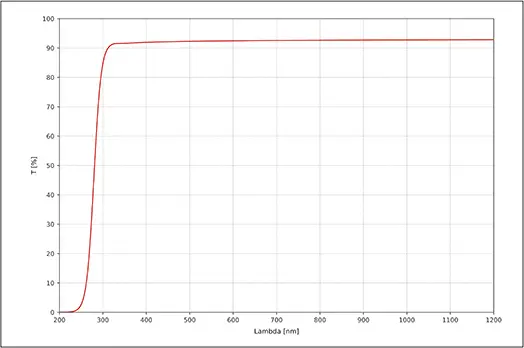
PYREX® Micro-Electro™ Glass
UV Transmittance
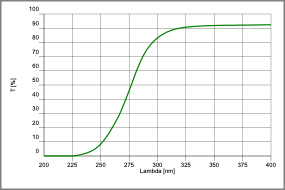
Standard glass thicknesses
Please click on glass thickness to start a request:| Thickness (mm) | Tolerance |  |
|---|---|---|
| 0.50 | ±0.02 | ✔ |
| 0.70 | ±0.02 | ✔ |
| 1.10 | ±0.02 | ✔ |
| The thicknesses marked with "✔" are also available within our 48-hour express service. | ||
| Other glass thicknesses (from 0.2 to 1.4 mm) are available upon request, provided the order quantity is sufficient. Please send us your inquiry in case of need. | ||
Refractive Index
- nd = 1.472 (589.3 nm)
Density
- 2.234 g/cm3
Young's Modulus
- 61.5 GPa
Poisson's Ratio
- 0.19
Shear Modulus
- 25.8 GPa
Vickers Hardness
- 520 kgf/mm2 (200 g load)
Coefficient of Thermal Expansion (0–300 °C)
- 3.39 × 10⁻⁶ /°C
Viscosities
- Annealing Point (1013 dPas): 546 °C
- Strain Point (1014.5 dPas): 498 °C
- Glass Softening Point: 814 °C
| Thermal Conductivity (specific heat × thermal diffusivity × glass density) |
|||
|---|---|---|---|
Temperature (°C) |
Specific heat (J/kg×K) |
Diffusivity (cm2/sec) |
Conductivity (W/m×K) |
47 |
724 |
0.0064
|
1.10 |
99 |
781 |
0.0062
|
1.10 |
204 |
960 |
0.0060
|
1.29 |
304 |
1073 |
0.0058
|
1.42 |
406 |
1104 |
0.0058
|
1.42 |
505 |
1214 |
0.0059
|
1.56 |
| Dielectric Constant | ||
|---|---|---|
Frequency (GHz) |
Dielectric Constant |
Loss
Tangent |
0.5 |
4.68 |
0.0041
|
1 |
4.66 |
0.0045 |
2.5 |
4.61 |
0.0064 |
5 |
4.58 |
0.0073 |
7.5 |
4.57 |
0.0078 |
10 |
4.55 |
0.0084 |
Volume Resistivity
- log10(Volume Resistivity) @ 250°C: 8.01 Ω x cm
Chemical Durability
The durability is measured via weight loss per surface area after immersion in the solvents shown in the table. Values are highly dependent upon actual testing conditions.| Solution | Reaction time/
Temperature |
Weight loss
(mg/cm2) |
|---|---|---|
| HCl – 5% | 24 h at 95 °C |
0.00 |
| NH4F:HF – 10% | 20 min. at 20 °C |
0.21 |
| HF – 10% | 20 min. at 20 °C |
0.89 |
| NaOH - 5% | 6 h at 95 °C |
3.06 |
Further detailed specifications are available on request.
All data and specifications given are average guide values and are not guaranteed. Moreover, please consider the “Notes on Specifications”.© 1994 – 2026 Präzisions Glas & Optik GmbH
Last update: July 31, 2026